
The policeman who earned his solutions
Freeman Wills Crofts built his detective fiction on a proposition that most of his contemporaries preferred to ignore: solving a murder is a job, and jobs are mostly repetitive, mostly unspectacular, and mostly about not being wrong. Inspector Joseph French of Scotland Yard is the instrument of that proposition. He has no cocaine habit, no private income, no deductive theatrics. He has a notebook, a railway guide, and a superintendent who expects results.
Crofts came to the novel late and from an unusual direction. A railway engineer in Ireland, he reportedly sketched out his first plot during a long convalescence in the years before 1920. The result, The Cask (1920), is a masterpiece of logistics: a consignment of wine arrives in London with a woman's finger visible among the packing, and the story that follows is largely an account of tracking a barrel across two countries by documentary evidence alone. French does not appear in that first novel, but the method is already fully formed. When French does arrive, in Inspector French's Greatest Case (1924), he steps into a procedure that Crofts has already established: the alibi is not a puzzle to be solved by inspiration but a structure to be dismantled by work.
Timetables as the architecture of guilt
The alibi is Crofts's central machine. Where other Golden Age writers used the alibi as an obstacle for their detective to vault elegantly, Crofts uses it as the substance of the novel itself. Timetables and alibis are not background detail in his fiction; they are the plot. French moves through them the way a surveyor moves through terrain — taking measurements, cross-referencing, returning when something does not quite fit. A train that left at 9:47, a witness who was at a particular platform, a car journey that took twelve minutes longer than it should: these are the materials.
Chronology
The Squad- 1920The Cask, Crofts's first novel; the alibi-and-logistics method already established
- 1924Inspector French first appears in Inspector French's Greatest Case
- Post-WWIIEd McBain and the squad-room procedural extend the unglamorous tradition French exemplifies
The technique produces a specific kind of reading experience, closer to watching someone lay bricks than watching someone fence. Crofts understood this and did not apologise for it. French is cheerful, domestic, fond of his wife Emily, and entirely without pretension to genius. When he is wrong — and Crofts allows him to be wrong at length, pursuing false trails that consume chapters — he backtracks, resets, and starts again. The false trail is not wasted narrative; it demonstrates that the method requires elimination, and elimination requires error.
This is the procedure that separates French from contemporaries like Poirot or Lord Peter Wimsey. Hercule Poirot's famous little grey cells promise that superior cognition will eventually light up the truth. French makes no such promise. He files a report. He checks the file against new information. He revises. The solution arrives not as illumination but as the point at which every other possibility has been closed off.
Legibility and the cost of patience
What Crofts sacrificed for this method was atmosphere and psychological depth. His murderers tend to be calculating rather than passionate; their motives are financial. His victims are less characters than premises. The Detection Club, of which Crofts was a member, swore its detectives to fair play — every clue available to the reader — and French's cases honour that commitment scrupulously, but the world they inhabit is grey and functional. The pleasures on offer are legibility and rigour, not texture.
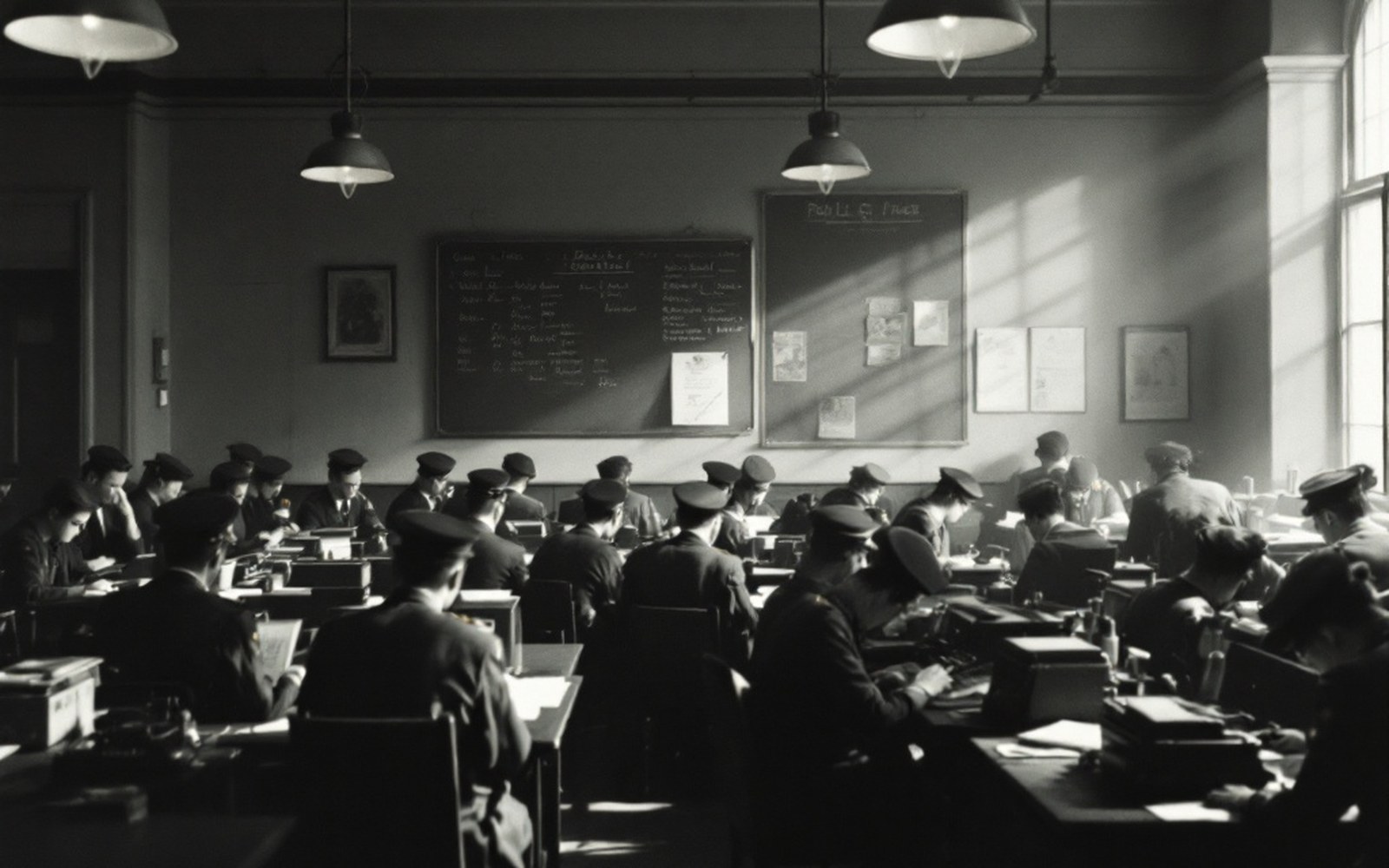
That narrowness is also a kind of integrity. Crofts never cheats the procedure. When French reconstructs a journey, Crofts has done the arithmetic. When a witness's account is inconsistent by four minutes, those four minutes matter. The novel becomes, in this way, a case file with a human face attached — French's solid, professional, slightly tired face.
The procedural novel that Ed McBain and others would develop after the Second World War made the squad room its unit and depersonalised the method further. But the unglamorous ethics of that tradition — the idea that detection is labour performed by working people against time and incomplete information — are already fully present in Freeman Wills Crofts, in the 1920s, in the careful steps of a policeman checking the timetable again.
Related entries
Elsewhere in The Squad