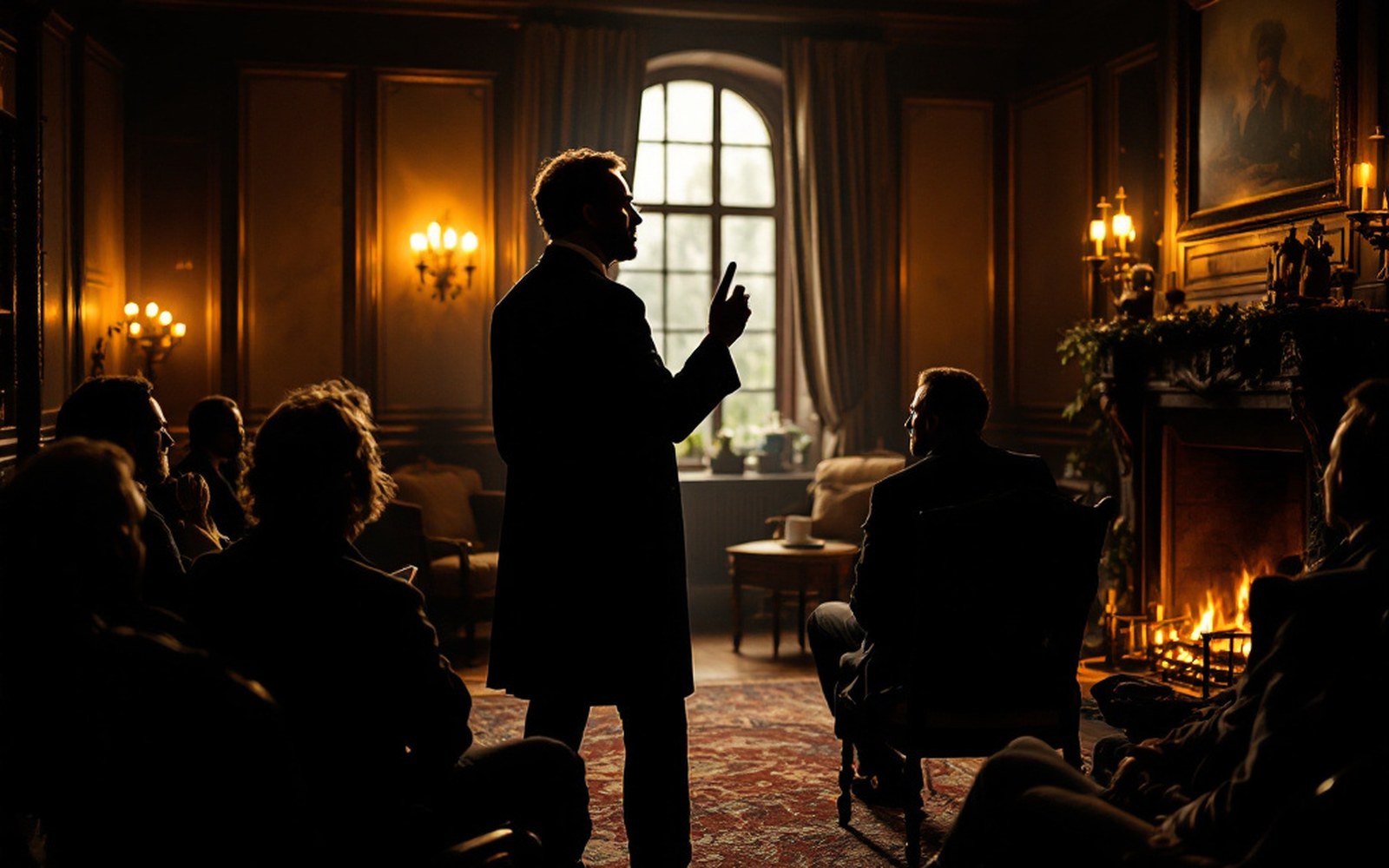
The lecture begins
A fictional detective catalogues every possible solution to the impossible crime — inside the novel itself, while the plot waits.
In The Hollow Man (published in the United States as The Three Coffins), John Dickson Carr paused his 1935 novel to let his detective, Dr. Gideon Fell, address the reader directly on the mechanics of the locked-room problem. The murder has occurred; the suspects are established; and then, in Chapter Seventeen, Fell sits down in a public house and delivers a systematic taxonomy of every method by which a killer might make a room appear sealed from the inside. The plot stops. The lecture begins.
Fell opens by acknowledging the artificiality of the moment — he remarks that he and his companions are characters in a detective story, and they know it. The self-referential gesture is deliberate and exact. Carr is not being playful at the expense of the puzzle; he is being honest about what the puzzle actually is. A locked room is a machine with a finite number of moving parts, and Fell names them all so that readers can measure what they are about to be shown.
The lecture's categories
5 entries · The Mechanism- 01Timing, not mechanism — murder committed before or after the room was sealed
- 02Apparent sealing — witnesses wrong about what they found
- 03Automatic device — bolt or latch triggered without the killer present
- 04Physical escape — route that seemed impossible (window, chimney, passage)
- 05Staged death — suicide or accident misread as murder
What Fell catalogues
The lecture organises itself into classes. First: the murder was committed before or after the door was locked, not during — the timing is the trick, not the mechanism. Second: the room was never actually sealed at all, the witnesses are mistaken or lying about what they found. Third: the room is sealed but the means of sealing it operated automatically, triggered by the victim or by a device the murderer had already set. Fourth: the murderer was inside the room and escaped by a physical route that appeared impossible — a window too small, a chimney, a concealed passage. Fifth: suicide staged to mimic murder, or accident misread as either.
Each category subdivides. A weapon can be carried into the room before the crime and removed through a gap too narrow for a person. Ice, wax, or a mechanical contrivance can throw a bolt after a door is closed. A cord threaded through a keyhole can turn a key from the outside. Fell is methodical because Carr is methodical; the lecture is also, in effect, Carr's notebook made public — and the catalogue works as a clue in plain sight:even once you know the categories, you still have to identify which one the solution belongs to before the reveal.
Why stopping the novel works
The lecture is sometimes called the locked-room lecture in critical writing on detective fiction, and it has functioned as a reference text for the subgenre ever since. Douglas Greene's biography of Carr, the fullest account of his working methods, traces how completely Carr was preoccupied with the impossible crime — he returned to the form across dozens of novels under his own name and as Carter Dickson, generating solutions that correspond to almost every category Fell describes.

The lecture works because it respects the reader's position. Fair-play detection operates on the principle that all necessary information is available before the solution is announced; Fell's catalogue extends that contract to the structural level, not just the clue level. You now know the range of possibilities. The question is which one Carr has used — and whether he has combined two in a way the lecture quietly allowed for but did not highlight.
There is nothing like it elsewhere in Golden Age fiction. S. S. Van Dine prescribed, in his twenty rules, that the culprit must be a person who has played a prominent part in the story; Knox legislated against secret passages. Neither stopped to explain, mid-narrative, how the whole machinery worked. Carr did, because he was confident enough in his solution to show you the lock before he showed you the key.
Related entries
Elsewhere in The Mechanism