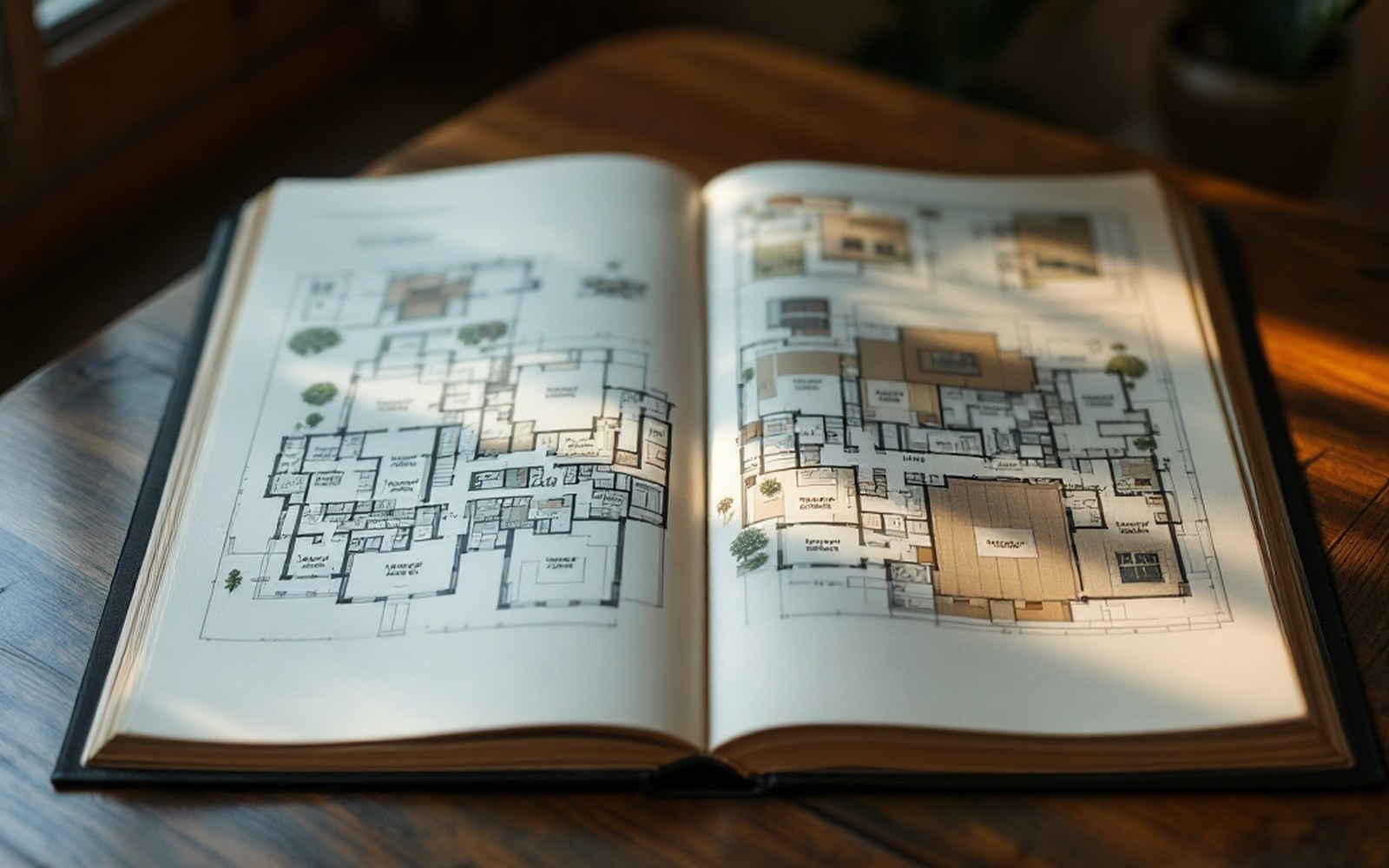
A map is also a contract
The floor plan printed at the front of a Golden Age detective novel is easy to mistake for decoration. It is not. It is a structural commitment — a statement, made before the story begins, that the physical space of the crime is fixed, finite, and knowable, and that whatever solution the author produces will fit inside it.
The convention belongs to a specific moment. The English country house, with its corridors, servants' stairs, morning rooms, and locked studies, became the dominant setting for detective fiction in the 1920s and 1930s not merely because it flattered the readership's fantasies but because it was architecturally ideal for the puzzle. A country house is a closed system. Arrivals and departures can be tracked. Every window and door can, in principle, be accounted for. The plan makes that accountability visible.
What the plan actually promises
When a floor plan appears on a preliminary page — oriented, dimensioned, labelled — it is doing at least three things at once. It establishes the geography the reader must hold in mind while tracking movement. It allows the author to plant a clue in the architecture itself, a window too high to reach or a distance between rooms that makes a character's alibi geometrically impossible. And it constitutes a form of fair play: the evidence is literally on the page before the story opens.
What the plan does (three functions at once)
3 entries · The Room- 01Orientation — gives the reader a stable geography to track movement against
- 02Architecture as evidence — distances, sight-lines and door positions become clues the reader can check
- 03Fair-play contract — the relevant spatial fact is on the page before chapter one opens
Agatha Christie used floor plans regularly, and the ones that matter most are not merely illustrative but argumentative. The plan in The Murder at the Vicarage (1930) gives the reader the sight-lines between buildings: who could have seen what from where becomes a geometric question, not a vague impression. Christie's attention to layout is what makes the misdirection in several of her finest books possible at all. The plan shows the reader everything the murderer needed — and makes the reader look at it without seeing it.
John Dickson Carr, whose impossible crimes depend on the physical integrity of a sealed space, used architecture as his primary mechanism. In Carr's world, the sealed chamber is not simply a dramatic situation but a logical puzzle, and the plan is the schematic that lets the reader run through solutions independently. Without a ground plan, the reader has only the author's word for where things were. With one, they have evidence they can interrogate.
Freeman Wills Crofts took a different approach but an equally rigorous one. Where Christie and Carr dealt in theatrical impossibilities, Crofts built his crimes on plausibility: the right distance between the garage and the library, the correct number of minutes a car would take to reach the road. His plans, like his timetables, are working documents. You can check the arithmetic.

The plan as a device of constraint
What the plan does for the author is as important as what it does for the reader. It commits the writer to a spatial reality that cannot be quietly revised mid-novel. The distance between the billiard room and the master bedroom is not whatever is convenient when the solution needs to be written. It is whatever is printed on page four. This is the reason good Golden Age authors drew their plans early, not as illustrations to commission at the end, but as foundations to build on.
Dennis Wheatley took the logic of spatial evidence to an extreme in his Crime Dossier series of the 1930s — physical facsimiles of a case rather than a novel — but the floor plan in a standard detective novel serves the same impulse: make the crime dossier legible, the space auditable, the solution something the reader could in principle have reached before turning to the last chapter.
The floor plan is, in the end, a kind of honesty. It says: the world of this book has walls, and the walls are where you see them. Mystery is permitted; impossible crimes must still obey the geometry printed at the front. That is the promise the map makes, and a fair-play novel is obligated to keep it.
Related entries
Elsewhere in The Room