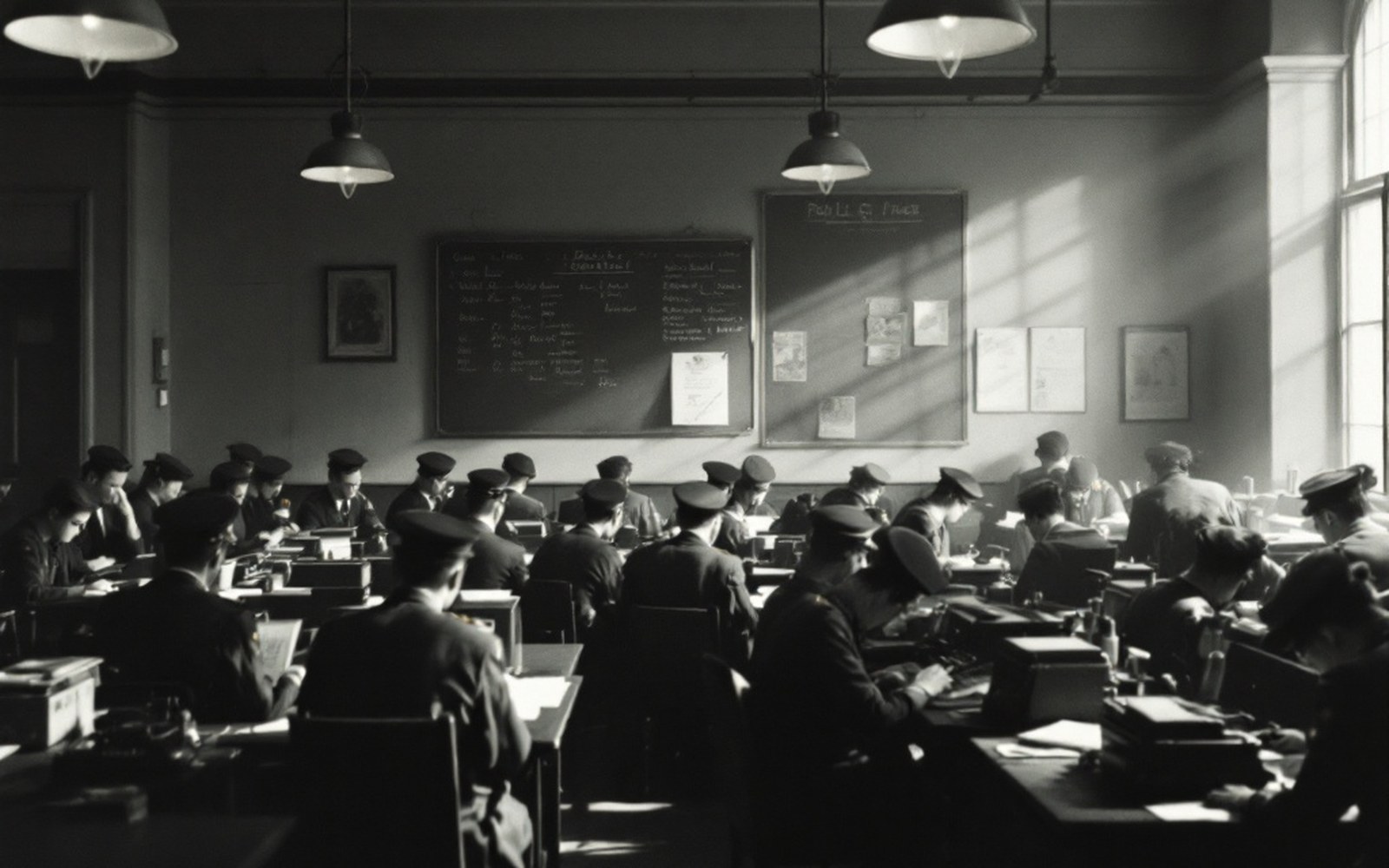
The Squad Room as Protagonist
The single genius detective is an economy of storytelling: one intelligence orders the world, sees what others miss, and delivers meaning at the end. What Ed McBain did when he launched the 87th Precinct series in 1956 was dismantle that economy completely. He replaced the sovereign mind with a room — a specific, cluttered, institutionally real squad room in a fictional American city called Isola — and the story changed shape around the substitution.
Isola is transparently Manhattan with the serial numbers filed off, which is itself a structural decision: McBain (born Salvatore Lombino, working also under the name Evan Hunter) wanted a city plastic enough to serve any story, but dense enough to feel like a real place accumulating real history. Over the decades that followed the 87th Precinct series ran to more than fifty novels, the city filled in. Neighbourhoods acquired weather and class and crime rates. The squad room acquired dented furniture, a permanently broken elevator and a coffee machine that nobody adequately maintained.
But the room is not just atmosphere. It is the structural mechanism. Where the Golden Age detective stands apart from institutions — Poirot is not Scotland Yard, Wimsey is an amateur, Holmes is consulted rather than employed — the 87th Precinct detectives are the institution. They clock in. They file reports. They hand cases off when shifts end. The novel's epistemology changes accordingly: knowledge is distributed, partial, and procedurally gathered, not delivered by a single act of ratiocination at the drawing room's end.
Formal mechanisms
4 entries · The Squad- 01Distributed knowledge — no single detective has full information; uncertainty is genuine, not deployed to protect a hidden solution
- 02Simultaneous cases — multiple investigations run in parallel within single novels, fragmenting narrative authority
- 03Institutional prose — lab reports, witness statements and official documents appear in their actual register, not summarised
- 04Accumulated time — characters age, marriages fail, cases remain unsolved across the run of the series
How the Ensemble Distributes Knowledge
Steve Carella is the closest the series comes to a centre of gravity — he appears in nearly every book, and his domestic life, his marriage to the deaf Teddy, gives the series a sentimental anchor. But McBain never allowed Carella to be the genius. He is a good detective in the way that a good plumber is a good plumber: experienced, methodical, occasionally lucky. Around him the squad distributes function rather than subordinating itself to his insight.
Meyer Meyer (the doubled name is a joke about an antisemitic father's sense of humour, delivered deadpan) brings patience and a civil disposition. Cotton Hawes, physically large and almost theatrically honest, arrives in the series as a transfer and never quite loses that outsider status. Bert Kling is young enough at the start that his mistakes are credible rather than stupid. The precinct also cycles in detectives who get their own cases and their own narrative weight. No single character controls information; no single point of view organises the evidence for the reader.
This distribution is not merely sociological texture. It is a formal choice that produces a specific reading experience. Where a Hercule Poirot novel deploys false leads to protect a solution that Poirot already knows, the 87th Precinct novels deploy false leads because the detectives actually don't know yet. The uncertainty is authentic rather than performed. Multiple cases run simultaneously in many of the books — a rape investigation, a murder, a missing person — and because no detective is omniscient, neither is the reader. The jigsaw puzzle model of fair play, in which all pieces are present and the final picture is guaranteed, gives way to something closer to the actual texture of investigation: gaps, dead ends, partial resolution, and occasionally no resolution at all.

McBain learned some of this from Dashiell Hammett, whose Continental Op stories showed that a detective embedded in an organisation thinks differently from a freelance eccentric. The Op does not have inspirations; he works. But Hammett's world was still filtered through a single consciousness. McBain's formal advance was to abandon even that. Nobody in the 87th sees the whole thing.
What Changes When Nobody Sees the Whole Thing
The formal consequences ripple outward from the distributional premise, and they are worth mapping precisely.
First, time works differently. A Carr locked-room novel compresses time toward a solution that explains everything and returns the story's world to equilibrium. The 87th Precinct novels run in something closer to real time, with cases that outlast individual books, characters who age, marriages that fail, and — most strikingly — a detective, Steve Carella's wife Teddy, whose sign-language communication is rendered on the page in a way that refuses easy readability. The city accumulates its dead. The precinct accumulates its paperwork. McBain never pretends that solving one case restores order.
The novel's epistemology changes accordingly: knowledge is distributed, partial, and procedurally gathered, not delivered by a single act of ratiocination at the drawing room's end.
Second, the mechanics of detection become visible rather than magical. Freeman Wills Crofts had already done this with Inspector French, making detection a matter of patient alibi-checking and timetable scrutiny. McBain pushed further: lab reports appear as lab reports, written in the institutional prose of actual forensic communication. Witness statements are quoted with the flat literalism of official transcripts. The police procedural form depends on this visibility — the reader is not being impressed by a private intelligence, but invited to watch a system work. The system's failures are part of that invitation.
Third, character accumulates under pressure rather than serving plot. In a Golden Age novel, a character's backstory is present only insofar as it generates motive or alibi. In the 87th Precinct series, Meyer Meyer's experience of antisemitism and Bert Kling's romantic disasters exist not to explain crimes but to explain people — people who then work crimes. This is a different kind of novel, one that the hardboiled writers cleared space for by insisting that environment and psychology mattered, but that McBain systematised in a way Chandler never attempted. Chandler's Marlowe is still a romantic individual, solitary and emblematic. McBain's detectives are colleagues.
The squad room itself enforces this. Physical proximity — shared desks, overheard phone calls, the particular exhaustion of shift change — produces a social world that the country house and the private consulting room specifically excluded. That social world is the procedural's subject as much as the crime is. Ed McBain did not simply invent a new setting. He understood that the setting was an argument about how knowledge works and who gets to have it, and he built that argument into the novel's structure, one case file at a time.
Related entries
Elsewhere in The Squad