When the envelope is part of the plot
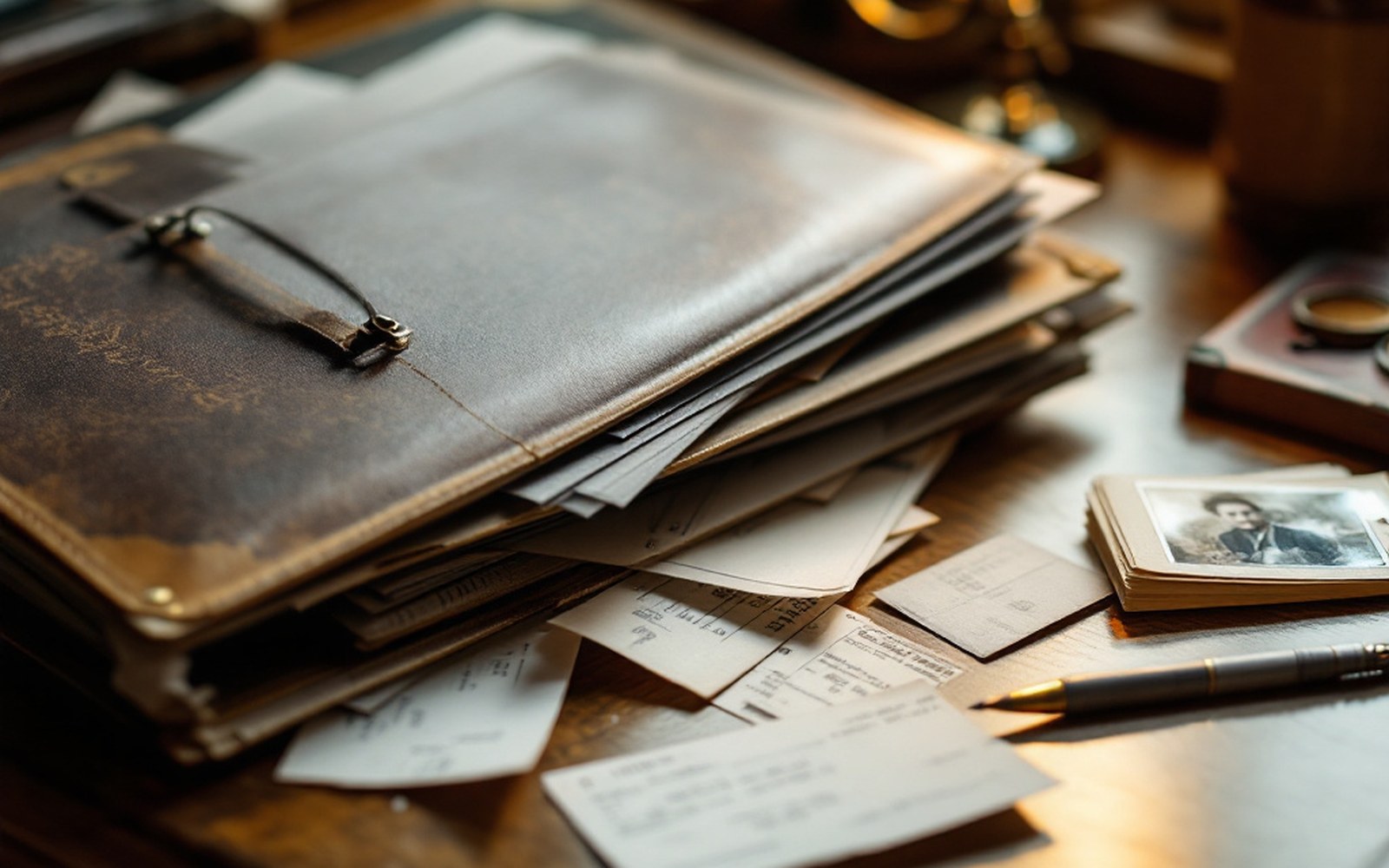
Some detective novels made their central promise physical. Instead of printing clues on the page, they put them in your hands — loose, folded, touchable. You reached into a cardboard wallet and found a theatre ticket stub, a typewritten telegram, a lock of human hair twisted in paper, a smeared fingerprint card. The reading experience became something stranger: part puzzle, part theatre, and the distinction between story and evidence briefly dissolved.
The most celebrated practitioner of the form was Dennis Wheatley, who produced four of these objects between 1936 and 1939 in collaboration with J. G. Links. Crime Dossier was their collective name for the series, and the first, Murder Off Miami (1936), established the template. The case arrived in a manila folder. Inside were photographs of the crime scene, a cabin plan, a passenger list, newspaper cuttings, a hotel receipt, a wisp of rope, a bloodstained scrap of cloth. At the back, a sealed section contained the solution, and the reader was challenged to name the killer before breaking the seal.
The conceit required a great deal of forward planning. Wheatley and Links had to design a coherent physical archive that would yield a genuine solution on its own terms, without novelistic prose to guide interpretation. Every item had to carry weight and be susceptible to scrutiny; the telegram's date, the receipt's hour, the knot in the rope. This was fair play pushed to a peculiar extreme — not merely the clue in plain sight on the page, but the clue physically present in the reader's hands, unable to be skimmed.
The dossier as object
3 entries · The Reader- 01Crime dossier — a book-format detective puzzle sold as a physical case file: manila folder containing facsimile evidence, documents, and a sealed solution section
- 02Facsimile evidence — reproduced items (telegrams, tickets, photographs, forensic samples) printed or manufactured to resemble original documents
- 03Sealed solution — a separate folder or section inside the dossier, not to be opened until the reader has reached a conclusion; a physical literalisation of the "sealed chapter" convention
The machinery behind the method
The form has antecedents. R. Austin Freeman had demonstrated, beginning with The Singing Bone (1912), that evidence and its interpretation were separable — that you could show a reader the exact mechanism of a crime and still sustain genuine mystery about guilt. What Wheatley and Links did was take that separation one step further: instead of narrating the evidence, they manufactured it. The facsimile telegram, the faked photograph, the printed fingerprint card were props in a drama, but they also constituted the actual reasoning material. There was no detective-narrator to filter them.
This absence of a narrator is the structural pivot on which the crime dossier turns. The canonical Golden Age puzzle — Christie's Poirot, Sayers's Wimsey — provides a fictional intelligence through whose eyes clues are weighted and red herrings distributed. The reader trusts, or suspects, that intelligence. Remove it, and the reader faces raw material with no mediated weight at all. The postcard is just a postcard. Whether it matters, and how, is entirely the reader's problem. The challenge to the reader — familiar in print as a page inserted into the novel before the solution chapter — here became an architectural fact, built into the object itself.
The sealed solution was another convention the dossier form borrowed and literalised. Where some British publishers produced editions with sealed final chapters, glued shut so purchasers could prove they had not peeked, the Wheatley–Links books simply placed the answer in a separate sealed folder inside the same packet. Breaking the seal was a distinct physical act, a commitment that you had finished your reasoning.
Evidence, authenticity, and the limits of the form
Production was demanding, which may explain why the form never became a mainstream publishing phenomenon. The four Wheatley–Links dossiers — Murder Off Miami, Who Killed Robert Prentice?, The Malinsay Massacre, and Herewith the Clues! — were elaborate objects assembled at real cost, and the challenge of reprinting them with all their enclosures intact has kept them collectors' pieces rather than widely reprinted texts. Collins, which built its Crime Club and broader crime output on the reproducibility of the standard novel, had no natural home for a format that demanded manufacturing work most paperback production lines could not accommodate.
There were American parallels, none quite so elaborately realized. The Mystery Writers of America, which from its 1945 founding worked to define and elevate the genre, engaged with puzzle construction at a craft level, but the crime dossier as a physical object remained a British eccentricity, rooted in a particular inter-war appetite for elaborate entertainment — the same culture that produced Dennis Wheatley's occult thrillers and the Detection Club oath's theatrical trappings.
Wheatley and Links had to design a coherent physical archive that would yield a genuine solution on its own terms, without novelistic prose to guide interpretation.
What the form exposed, almost inadvertently, is how much the detective novel depends on prose to do work that evidence alone cannot do. A train timetable in a Freeman Wills Crofts novel carries the reader's attention because the narrative directs it there; in a Wheatley dossier, the train timetable lies among nine other documents, and knowing which one matters is the puzzle before the puzzle. This is harder than it sounds. Golden Age novelists generally placed clues in a context that rendered them plausible as neutral observation. The dossier format, because it stripped all context, risked making the relevant clue conspicuous — why else would this specific receipt have been included? The compiler had to bury the salient item in a convincingly tedious archive, a craft challenge closer to prop design than to plotting.
Some items in the Wheatley–Links dossiers were pure atmosphere — a newspaper clipping that told you nothing about the murder but established a social world. Others were genuine reasoning material. The reader could not always tell which was which, and this uncertainty was the form's deepest trick: it simulated the experience of actual investigation, in which most of the available evidence turns out to be noise. The detective novel, ordinarily, curates your reality. The crime dossier handed the curation problem back to you, inside a manila envelope, and waited.
Related entries
Elsewhere in The Reader